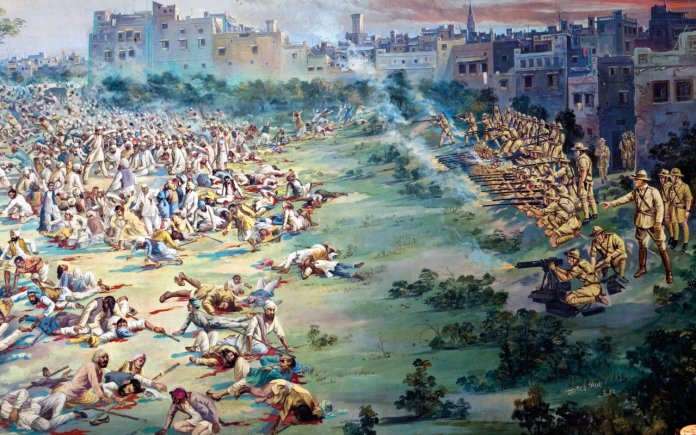
Intro: A hundred years ago British soldiers opened fire on a crowd of unarmed Indians. The massacre still haunts the history of empire today.
ON the morning of 10 April 1919, the city of Amritsar in Punjab found itself in the fiery grip of anti-colonial protests. The day had begun peacefully enough, but by early afternoon the town was up in arms as mobs of baying men shouting nationalistic slogans embarked on a spree of pillaging and burning. Britons who actually held power and sway over them were beyond reach, and so anybody with white skin became a target. Officials at the National Bank were severely beaten and stabbed, their bodies badly burned in a heap of office furniture and stationery. At the Alliance Bank, too, the manager was thrown out of the window, his decapitated and mangled corpse set on fire afterwards. While others began to rain blows on a statue of Queen Victoria, this was tempered somewhat as it had been argued that Her late Majesty ought not to be held responsible to the faults of her successors. With only marginal damage, most of her iconic image was spared. Throughout these protests, the air rang with cries of “Gandhi ki jai” (victory to the Mahatma), an irony which had taken a leave of absence at the very first eruption of disorder and violence.
As it happens, this is one of the many striking scenes that emerges from Kim Wagner’s excellent new book on the Amritsar Massacre of 1919. It is, undoubtedly, an intelligent and unsentimental insight into one of the most horrifying moments in the history of the Raj.
The events at Jallianwala Bagh on 13 April are well documented. Brigadier-General Dyer of the British Indian Army, one of the great villains of India’s colonial experience, had his soldiers open fire on a gathering of between 5,000 and 10,000 unarmed civilians in a confined garden. Hundreds were killed, while a thousand more lay wounded, unable even to seek aid due to curfew orders. As Wagner writes, the episode became “one of the best-known items on the imperial butcher’s bill” – not least because Dyer and his superiors showed little remorse. But while they were quick to telegram support, “Your action correct and Lieutenant Governor approves”, Dyer was lambasted in the House of Commons although he was lauded as a good soldier in the Lords. And as late as 1978, a subordinate defended him: he “killed, yes”, but “massacred, no”. The number of fatalities remains uncertain: Dyer claimed 200-300, estimated loosely from the 1,650 rounds fired, while the Indian National Congress suggested 1,000 people perished. An official commission into the massacre settled for 379, including a six-week-old baby.
A principle intention of Wagner’s study is to make historical and scholarly sense of this tragedy (as opposed to political or emotional). Some might suggest that both parties thought their actions legitimate. But, how did a massacre of this scale resemble justifiable military action for the Raj’s officials? Despite the atrocity he authored and approved, how did Dyer become the man who “Saved India”? To any neutral observer or reader of the situation this is a perfectly reasonable question to ask. He will be perceived in some quarters as butcher rather than saviour. And, how was it that thousands of people who set out with Gandhi’s name on their lips, could burn and loot, assaulting a middle-aged white woman and leave her for dead?
The nuanced approach applied by Wagner attempts to explain the inner workings of both sides. The Indians were certainly the victims, that there is no doubt: despite their violence on the eve of Jallianwala Bagh. Bricks and sticks ought never to have provoked any government to prepare air power against the people it governed. In the end, Amritsar narrowly escaped being bombed, but at nearby Gujranwala gunfire was indeed opened from above, with as many as eight bombs dropped on villagers. It was a disastrous overreaction, but one borne-out of paranoia that was as old as the empire itself.
Wagner scrutinises this paranoia with careful deliberation. Too often, he notes, Amritsar is viewed in isolation or as a catalyst for the concluding chapter in India’s struggle for freedom: it was in response to Jallianwala Bagh that Gandhi launched his movement of non-cooperation. He turns the focus on the decades that preceded Dyer, casting his actions as the culmination of a previous chapter. It is a compelling argument, and it helps us understand the gap between ruler and ruled more fully. The British were, it should be remembered, aliens in a large and complicated country, conscious that their power was never secure. Confidence where it did not exist was feigned. Confronted by bewildering diversity, the British introduced rigid one-size-fits-all rules and a cumbersome bureaucracy that eschewed face-to-face interactions with its people. Racial fallacies and misconceptions, missionary polemics and changes at home all affected India, but instead of bridging gaps, distances were exacerbated by a ruling class that remained perpetually aloof.
Sporadic small-scale mutinies occurred, but in 1857 northern India rose in revolt in the Great Rebellion, when Hindus joined with Muslims under the banner of an emasculated Mughal emperor. Whilst British power had clearly been rattled, instances of violence against British women and children were deliberately exaggerated. Such rumours led to horrified reactions at home and a brutal military response. The debacle saw power transferred from the East India Company to the Crown, and Queen Victoria issued a proclamation with several guarantees to her Indian subjects (later innovations such as income tax were resisted by citing the proclamation). The essential preoccupation of the British in India – of “the men on the ground” – was to maintain control and resist any challenge to what they feared was a tenuous authority.
A great deal came to depend on the attitude of the viceroys appointed by the Crown. Some won popularity among Indians – Lord Ripon’s progressive reforms, for example, alarmed his own countrymen – but, for nearly all of them, concessions would not be traded for control – which, in effect, limited their actions to tokenisms and kind words. Theoretically, rule under the Crown was meant to be more liberal than during the East India Company era. In reality, it soon became business as usual.
Wagner offers an explanation for the unyielding attitude of the Raj’s officials. In 1857 British power had come close to being extinguished: it was reasserted only with spectacular violence. The Mughal emperor was packed off to Burma on a bullock cart and violent punishments were designed for the rebels. In the 1870s, it was proposed that “blowing from a gun is an impressive and merciful manner of execution,” for it was “well-calculated to strike terror into the bystanders.” Or, in other words, for the British to control an unpredictable people, the colonial state had to be prepared to deploy violence – and to make it a public affair. When some openly criticised such methods, there was the press to ramp up support. “The truth is we want omelettes without the breaking of eggs,” declared the Anglo-Indian newspaper the Pioneer. In the years and decades preceding the Amritsar Massacre, these fears played in the minds of colonial officials: as Wagner writes, “In the British colonial imagination, the ‘Mutiny’ [of 1857] never ended.” In the circumstances, it was not surprising that mass gatherings began to look like founts of sedition.
In 1907, for instance, the government imagined local leaders in Punjab as being part of a Russian-Afghan conspiracy – and, in 1915, an unlikely revolt organised by Indian expatriates in America reinforced such fears. The Rowlatt Act of 1919 set the stage for crisis as political liberties were curtailed: people could be arrested without warrant and detained without trial, and the press was gagged, all in the name of security.
Public meetings were planned in Amritsar by prominent figures, but on the 10 April, they were taken into custody. The crowds gathered and protested and demanded a meeting with the authorities. The sheer size caused such concern to British officials that shots were fired. Several Indians were killed: the riots, in which bank officials were lynched and the banks looted, was the response. “Just as the British misread the nature of the protests,” writes Wagner, “so too did the population of Amritsar fail to grasp the extent to which their mass protests sent the authorities into paroxysms of panic.” Officials were hardened by seeing a “fanatical” mob; the masses saw nothing but arrogant officialdom. Add to this mix “the brute reality of popular politics” and the “dynamics of crowd violence”, and the stage was set for Dyer.
Dyer, the head of the 45th Brigade at Jalandhar, some 50 miles away, was not summoned to Amritsar, he appeared uninvited. He told his son: “There is a big show coming.” Martial law was imposed, and all public gatherings banned, but the men sent out to announce this did a hopeless and poorly executed job of the orders. Most people remained oblivious as to what was happening. A meeting previously planned went ahead, with Dyer promptly decreeing this as undisguised provocation. “I was conscious of a great offensive movement gathering against me,” he later wrote, “and knew that to sit still… would be fatal… I knew a military crisis had come and that to view the assembly as a mere political gathering…was wholly remote from the facts.”
For Dyer, Amritsar was “the storm centre of a rebellion”. Other officials, too, interpreted every hint of discontent as the rumblings of a treacherous conspiracy. “My mind was made up… If my orders were not obeyed, I would fire immediately.” To not act would entail the military losing face, and this would embolden refractory “natives”. Dyer insisted that he was simply doing his “horrible, dirty duty”.
There was another figure, aside from the synonymity of Dyer with Amritsar, whose views shaped British responses at that time: the man who telegrammed Dyer his words of approval, Sir Michael O’Dwyer, Lieutenant Governor of Punjab. Born and raised in Ireland to dislike nationalists in his own country, O’Dwyer brought his imperious style to India. As Anita Anand writes in her new book on Amritsar, ever since his arrival, “the new Lieutenant Governor had been categorising Indians like a botanist documenting interesting but potentially dangerous specimens”. The Mahratta Brahmin was “intelligent… but often treacherous”. O’Dwyer’s language was often putrid and unseemly labelling many in India as “virile” and, unless firmly and tactfully handed, “obstinate to the point of fanaticism.” When legal obstacles were raised, the trenchant O’Dwyer dismissed the courts as taking “too technical and narrow” a view of evidence. It should come as no surprise that he and Dyer got along just fine.
The Patient Assassin by Anand is primarily the story of Udham Singh, the revolutionary who would assassinate O’Dwyer in 1940 in belated retaliation for Jallianwala Bagh. The narrative is dramatic and fast-paced, with the protagonist bringing everyone together from the Soviets to the Americans. Very little is known about Udham’s early life, and what is known is enveloped in myth and misconception. When Udham claimed he was in Jallianwala Bagh on that fateful day in 1919, it was unclear whether he was even in the city. Either way, as he put it after shooting O’Dwyer, “For full 21 years [sic] I have been trying to wreak vengeance.” For him “the real culprit” who wanted to “crush the spirit of my people” was not Dyer but the ex-Lieutenant Governor.
Udham Singh began life as Sher Singh – and, in his lifetime, would also become Ude Singh, Frank Brazil, Mahomed Singh Azad, and finally Prisoner 1010. He had lost both his parents and his brother by the age of 16. Raised in an orphanage, he acquired carpentry as his only skill. Towards the end of 1917, he enlisted into the British Army, serving briefly in Basra before being deemed unfit for service. There was an impetuosity and impulsiveness about him, a yearning for greatness, a confused but determined love for his country, and a charm that often got him out of tricky corners.
It was thanks to his powers of persuasion that in 1918 he managed to re-enlist in the army, before retiring to Amritsar in more honourable circumstances after the war, in 1919. He was attracted to the politics of the Ghadar Party – that network of expatriates who sought unsuccessfully and often amateurishly, to liberate India by force – and became a pamphlet mule, spreading their message around Amritsar and in the wider Punjab. The urge to make a difference, though, had to be carried alongside that other urge to feed himself, so that by 1920 in was in Africa working for a railway line like thousands of “coolies”.
Anand does a meticulous and determined job of tracing his steps and is able to debunk more than one theory about him. Surprisingly, given that the Ghadars are integral to Udham Singh’s tale, Anand doesn’t offer anywhere near as a complete treatment of the political party as one would reasonably expect. He encountered them again in Africa: later sailing back to India with more sedition in his suitcase. By 1922, he embarked to the United States, where he rose in their underground ranks while working as a mechanic. Whenever immigration caught up with him, Udham moved, until 1927 when he quit the country. Returning to Amritsar, he was apprehended, and, after confessing to his political activism with the Ghadars, was imprisoned.
In another mystifying twist, he had acquired a fresh passport by 1933, and set out for London. In the years that followed, he found himself a mysterious English girlfriend, working as a peddler of clothing and household goods, sang the praises of the revolutionary hero Bhagat Singh, appeared as an extra in the 1937 movie Elephant Boy, and in 1940 finally accomplished what he had pledged to do: by assassinating Michael O’Dwyer.
On the afternoon of 13 March, O’Dwyer attended Caxton Hall in Westminster to hear a lecture on Afghanistan. His assassin was waiting in the audience. When at the end of the event, the 75-year-old rose to talk to the speakers, Udham approached and shot him twice through the heart at close range, before turning his revolver on three other senior Raj officials, who were injured but not killed. One of the first things Udham did after being taken into custody was to ask police for a cigarette.
After he was hanged in an English prison, Udham laid for decades buried under English soil. In 1974, his remains were handed over to the Indian government, and in 2018, a statute was installed at Jallianwala Bagh. But Udham Singh remains an enigma: he was resident in London in the 1920s when he could easily have achieved his goal – why he didn’t we cannot say. Despite the almost impossible task of truly understanding Udham’s motivations, Anand does produce an engaging account of the times and of this unlikely hero. And though she is gripped by her subject, the author does not shirk away from his human failings. His legend now has it as picking up the bloodied earth from Jallianwala Bagh and vowing revenge for his murdered “brothers and sisters”. That his how his new statue depicts him. A century on, understanding the events of 1919 in a dispassionate historical sense, is essential. Anand achieves that in diligent and studious literary style.
HOW these two remarkable books will be received in India is uncertain. A hundred years later, Amritsar is still a deep wound that has still not healed. There are portions in Wagner’s book which will sit especially uneasily with hyper-nationalists. Visiting British dignitaries, from Queen Elizabeth to David Cameron, have expressed regret about 1919 – the former called it “distressing” while the latter saw it as “deeply shameful” – but an outright apology has never been offered.
Perhaps this year the British government might be inspired to say the words it has so far avoided. So central has Amritsar become in collective memory that a sincere expression of remorse would not only offer closure for relatives of those who suffered from the orders issued by Dyer but could encapsulate all other acts of injustice sponsored by the Raj. Surely this is something worth the British government’s attention, 100 years after one of its own instigated a massacre against unarmed civilians.
Appendage:
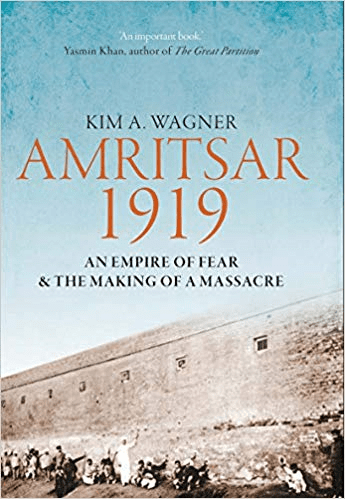
Amritsar 1919: An Empire of Fear & the Making of a Massacre, by Kim A Wagner, is published by Yale University Press, for £20, 360pp
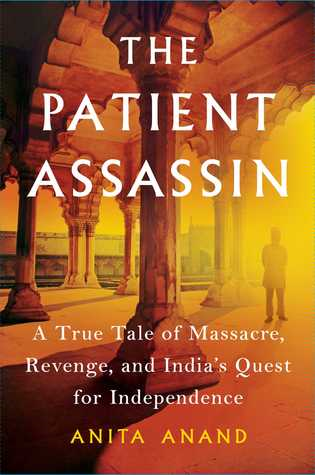
The Patient Assassin: A True Tale of Massacre, Revenge and the Raj, by Anita Anand, is published by Simon & Schuster, for £20, 384pp



 Arts, reviews & current affairs