Arts, Philosophy, Society

(Philosophy) ‘Republic’ and ‘Politics’

CONSTITUTION

BOTH Plato and Aristotle extended their theories into political philosophy, examining how best society could be organised. Each took a different approach and methodology in their examination and, unsurprisingly, reached a different conclusion. Plato’s Republic described his vision of a somewhat authoritarian city-state governed by specially educated philosopher-kings, whose knowledge of the Forms of virtue made them uniquely qualified to rule.

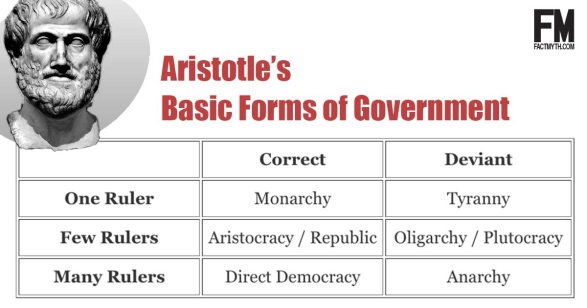
Aristotle applied a more systematic approach in his Politics. He analysed the possible forms of government, categorising them by criteria of “Who rules?” (a single autocratic person, a select few or the people?) and “On whose behalf?” (themselves, or the state?) He identified three forms of true constitution: monarchy, aristocracy and polity (or constitutional government). These all ruled for the common good, but when perverted, became tyranny, oligarchy and democracy. Given a choice, Aristotle believed that polity was the optimal form of government, with democracy the least harmful of the perverted forms.

Appendage:Forms Of Government

Standard
Arts, Literature, Philosophy

(Philosophy): Aristotle’s teaching of ‘happiness’

HAPPINESS

Aristotle (384–322 BC): ‘Happiness is the highest good, being a realisation and perfect practice of virtue, which some can attain, while others have little or none of it.’

The term “polymath” is often used in a somewhat hyperbolic sense to describe a significant figure who excels in several different disciplines. In modern parlance, for example, a sportsperson who writes a newspaper column, has an interest in current affairs and wins a televised ballroom-dancing competition is often erroneously described as being a polymath.

The sheer range and depth of Aristotle’s contribution to Western philosophy cannot be underestimated. Aristotle wrote on subjects as varied as physics, metaphysics, poetry, theatre, music, logic, rhetoric, linguistics, politics, government, ethics, biology and zoology, while still finding the time to study under Plato, found his own academy – the Lyceum – and act as a private tutor to the young Alexander the Great. Aristotle’s main contribution to philosophy concerns his work on the study of formal logic, collected together in a series of texts known as The Organon, and the use of “syllogisms” in deductive reasoning. In basic terms, a syllogism is a method for arriving at a conclusion through constructing a three-step series of premises, usually a major premise, A, followed by a minor premise, B, via which it is possible to deduce a proposition, C.

    For example:
    Major premise: All men are mortal.
    Minor premise: Socrates is a man.
    Conclusion/proposition: Therefore, Socrates is mortal.

In order for step C to be a viable logical proposition, step A and step B must be true.

Aristotle is often credited with “inventing” the form, although in truth he was probably just one of the first people to explore formal logic in this manner, especially the way in which logic must proceed to avoid fallacies and false knowledge. Aristotle’s systematic approach to all of the disciplines to which he turned his enquiring mind displayed a love of classification and definition, and it is possible that where words did not exist for a philosophical phenomenon, Aristotle simply made them up.

The quote at the beginning of this article about “happiness is the highest good” comes from Aristotle’s Nicomachean Ethics, a series of ten scrolls believed to be based on notes taken from his lectures at the Lyceum. In the Nicomachean Ethics, Aristotle addresses the question of what constitutes a good and virtuous life. Aristotle equates the concept of happiness with the Greek word eudaimonia, although this is not happiness in an abstract or hedonistic sense, but rather “excellence” and “well-being”. To live well, then, is to aim at doing good or the best one can, for every human activity has an outcome or cause, the good at which it aims to achieve. If humans strive to be happy, the highest good should be the aim of all actions, not as a means to an end, but as an end in itself.

In this regard, Aristotle saw the pursuit of happiness as “being a realisation and perfect practice of virtue”, which could be achieved by applying reason and intellect to control one’s desires. In his view, the satisfaction of desires and the acquisition of material goods are less important than the achievement of virtue. A happy person will apply conformity and moderation to achieve a natural and appropriate balance between reason and desire, as virtue itself should be its own reward. True happiness can therefore be attained only through the cultivation of the virtues that make a human life complete. Aristotle also pointed out that the exercise of perfect virtue should be consistent throughout a person’s life: “To be happy takes a complete lifetime; for one swallow does not make spring.”

The Nicomachean Ethics is widely considered to have had a profound effect on the development of Christian theology in the Middle Ages, largely through the work of Thomas Aquinas, who produced several important studies of Aristotle that synthesised his ideas with doctrines concerning cardinal virtues. Similarly, Aristotle’s works also had an important role to play in early Islamic philosophy, where Aristotle was revered as “The First Teacher”.

Standard
Arts, History, Philosophy, Science, Society

Quantum Leaps: ‘Galileo Galilei’…

1564-1642

In both his life and through the imprisonment which he was forced to endure in the years leading up to his death, Galileo more than any other figure personified the optimism and struggle of the scientific revolution. He was responsible for a series of discoveries which would change our understanding of the world, while struggling against a society dominated by religious dogma, bent on suppressing his radical ideas.

Galileo Galilei, was an Italian physicist, mathematician, astronomer, and philosopher who played a major role in the Scientific Revolution.

Galileo Galilei, was an Italian physicist, mathematician, astronomer, and philosopher who played a major role in the Scientific Revolution.

…A Mathematician

Although he was initially encouraged to study medicine, Galileo’s passion was mathematics, and it was his belief in this subject which underpinned all of his work. One of his most significant contributions was not least his application of mathematics to the science of mechanics, forging the modern approach to experimental and mathematical physics. He would take a problem, break it down into a series of simple parts, experiment on those parts, and then analyse the results until he could describe them in a series of mathematical expressions.

One of the areas in which Galileo had most success with this method was in explaining the rules of motion. In particular, the Italian rejected many of the Aristotelian explanations of physics which had largely endured to his day. One example was Aristotle’s view that heavy objects fall towards earth faster than light ones. Through repeated experiments rolling different weighted balls down a slope (and, legend has it, dropping them from the top of the leaning tower of Pisa!), he found that they actually fell at the same rate. This led to his uniform theory of acceleration for falling bodies, which contended that in a vacuum all objects would accelerate at exactly the same rate towards earth, later proved to be true. Galileo also contradicted Aristotle in another area of motion  by contending that a thrown stone had two forces acting upon it at the same time; one which we now know as ‘momentum’ pushing it horizontally, and another pushing downwards upon it, which we now know as ‘gravity’. Galileo’s work in these areas would prove vital to Isaac Newton’s later discoveries.

…The Pendulum

Galileo’s earliest work involved the study of the pendulum, inspired by observing a lamp swinging in Pisa cathedral. Following further experiments, he concluded that a pendulum would take the same time to swing back and forth regardless of the amplitude of the swing. This would prove vital in the development of the pendulum clock, which Galileo designed and was constructed after his death by his son.

…Through The Telescope

One of the inventions Galileo is often mistakenly credited with today is the invention of the telescope. This is not true; there had been numerous early prototypes that had been mostly developed in Holland before him, and a Dutch optician called Hans Lippershey applied for a patent on his version in 1608. Galileo did, however, develop his own far superior astronomical telescope from just a description of Lippershey’s invention, and quickly employed it to make numerous discoveries. A strong advocate of the Copernican view of planetary motion, Galileo’s initial findings published in the Sidereal Messenger (1610) provided the first real physical evidence to back up this interpretation. As well as discovering craters and mountains in the moon, sunspots and the lunar phases of Venus for the first time, he also noted faint, distant stars which supported the Copernican view of a much larger universe than Ptolemy had ever considered. More importantly, he discovered Jupiter had four moons which rotated around it, directly contradicting the still commonly held view, including that of the Church, that all celestial bodies orbited earth, ‘the centre of the universe.’

…Galileo and Copernicus

Galileo’s Dialogue Concerning the Two Chief World Systems – Ptolemaic and Copernican, in which the Ptolemaic view was ridiculed, attracted the attention of the Catholic Inquisition when it was published in 1632. Threatened with torture, Galileo renounced the Copernican System. His work was placed on the banned ‘Index’ by the Church where it remained until 1835, and he was subject to house arrest for life. But the tide of scientific revolution Galileo had helped instigate proved too powerful to hold back.

After being forced to renounce his heliocentric view of the Earth, Galileo said:

… Nevertheless, it turns!

Standard