Britain, Economic, Energy, Government, Politics, Society

The naivety of our leaders on energy policy

ENERGY

WITH Russia playing hardball with natural gas supplies to Europe, and the power links between France and Britain temporarily disabled due to a fire, it should finally be dawning on our politicians that as worthy as Britain’s dash to be the G7’s greenest economy may be, our current system of energy supply is woefully ill-equipped to cope with the transformation.

The UK Business Secretary, Kwasi Kwarteng, is trying to cobble together a temporary rescue plan for the food supply chain and gas supplies.

What is certain is that consumers – both ordinary households and big energy users such as the steel industry – face horrendous price increases which could trigger a catastrophic rise in inflation.

The greatest paradox in the present energy crisis is that it has set off a chain reaction: there is a shortage of cheap gas to fire up fertiliser plants which, in turn, produce the carbon dioxide needed to keep food supplies plentiful.

In other words, the UK’s determination to become carbon neutral has drawn attention to the important role of CO2 – vital for the food and drinks industry – actually plays in our day-to-day lives. What is potentially really humiliating for Boris Johnson’s government is that this debilitating episode comes on the eve of the COP26 climate change conference in Glasgow that starts on October 31.

What the crisis reveals is the shocking geo-political naivety over the years of this country’s leaders when it comes to energy policy. The current policy is still highly dependent on natural gas. And it assumes that natural gas, which globally is in plentiful supply, will always be available as a backup when wind turbines fail to turn, and our aged fleet of nuclear plants are shut down for maintenance.

TWO

BUT it is an energy policy that assumes there is a benign regime in Moscow, open shipping lanes in the Middle East and that interconnectors – or power links – between the UK and France and the UK and Norway are in fine fettle.

Yet if just one these assumptions proves mistaken, gas supplies are reduced and the price of the natural gas that does arrive soars.

Among the reasons that German Chancellor Angela Merkel has been so fawning towards President Putin is that she recognises he holds the whip-hand on gas supplies.

That is because Gazprom, the Russian energy behemoth, controls the flow of gas from deep in the Urals into Germany as well as much of the rest of Europe, including eventually Britain.

The fact is that the UK is at the end of a very long pipeline, with supplies pretty much dependent on what Putin decides. And yet we have an eco-minded government that, because of its determination to meet strict carbon targets, is determined to end our use of coal and reluctant to grant new oil-drilling licences, for instance, to firms wishing to further develop the Cambo oilfield near Shetland.

Other European nations, such as the Netherlands, have dealt with the Moscow threat by building huge storage capacity which can withstand months of disruption. In the UK, our biggest storage site at Rough off the coast of East Yorkshire was shut down in 2017 because of safety and leakage concerns.

The belief was that secure liquid natural gas supplies, arriving from Qatar would ensure constant availability.

That judgment has proved flawed. The surge in gas prices in August and September has been truly alarming and is why the fertiliser processor CF Industries – American owned and quoted on the Nasdaq stock market – closed-down its operations, strangling supplies of carbon dioxide for the food industry.

Carbon dioxide is used in the nation’s abattoirs for stunning livestock before slaughter and has led to protests from the pig producers and turkey specialists. In frozen form carbon dioxide is used to produce the dry ice required to deliver fresh meat and poultry supplies to supermarket shelves safely.

In much smaller quantities, and no less important, dry ice is used to keep the Pfizer Covid jabs fresh on their way to vaccination centres. Even if new supplies of natural gas are secured, there will be the impact on inflation.

THREE

AND the numbers are startling, with the price of wholesale natural gas climbing by a staggering 800 per cent in August. That alone could add up to £400 to energy bills this autumn – particularly for those customers of small energy companies that have collapsed – leaving those least able to pay without heating in their homes.

The great breakthrough of a competitive energy market, where consumers can change suppliers at a click of a mouse on price comparison sites, is vanishing before our eyes.

The new players are falling like ninepins with four going into liquidation in recent weeks and many more on the danger list.

OFGEM, the regulator, will likely have to raise the cap, the highest average price for households, to a much steeper level.

The point is that energy prices do not stand alone.

They form a large part of the costs of every domestic manufacturing process including steel, cars and food. The UK’s consumer price index soared to 3.1 per cent in August, in a development which the Bank of England describes as transitory (temporary).

That increasingly looks far too optimistic. The inflation genie has been released and getting it back in the bottle could be hugely disruptive.


INSIGHT

. How has this energy crisis come about?

The reawakening of the global economy following the Covid pandemic has driven the demand for gas, both to heat homes and fuel power stations producing electricity. This has caused prices to surge. The UK is reliant on expensive gas imports in the winter via connector pipes from the continent, Norway and Russia, which has capped supplies. Wind levels have also been below expectations, making us more reliant on gas, nuclear and coal.

. What about energy bills?

Wholesale gas prices for winter are up 68 per cent in the past five weeks, and the price cap for household utilities from watchdog OFGEM is rising too. Some 15 million will see annual increases of £139, with more pain expected from next April.

. Why are small suppliers failing?

They offered cheap long-term tariffs to millions of households when wholesale prices were low, but then faced huge losses. Larger suppliers protected themselves – to an extent – by purchasing energy long in advance.

. What about their customers?

OFGEM transfers customers of collapsed firms to a new supplier. There is no risk people will lose power – but they will find themselves on much higher tariffs, likely to cost at least £400 a year more.

. What is the Government doing?

Ministers have held talks with their Norwegian counterparts in the hope of securing strong gas supplies through the winter. They insist there is no risk the lights will go out.

. What’s the link to food supplies?

A US company running fertiliser plants in Teesside and Cheshire shut down as the high cost of energy meant they were no longer economically viable. The sites produced CO2 gas which is vital to the entire food industry.

Business Secretary Kwasi Kwarteng has held talks with the US firm, CF Industries, in the hope production will restart. The Department for Food and Rural Affairs is also holding meetings with industry chiefs. It is likely that a taxpayer-funded solution will be found to minimise food shortages.


Thursday, 23 September

FEARS that Russia will starve Europe of vital supplies have been heightened following concerns from financial markets that British wholesale gas prices for October have shot up 16 per cent at the start of this week. The compounding effect on restricting supplies is starting to hit hard.

Moscow is restricting the amount of gas supplied to the Continent via Ukraine next month, according to market results of a key gas auction.

The decision will exasperate fears that Russia is rigging prices to undermine the UK and the EU’s economic recovery from Covid-19.

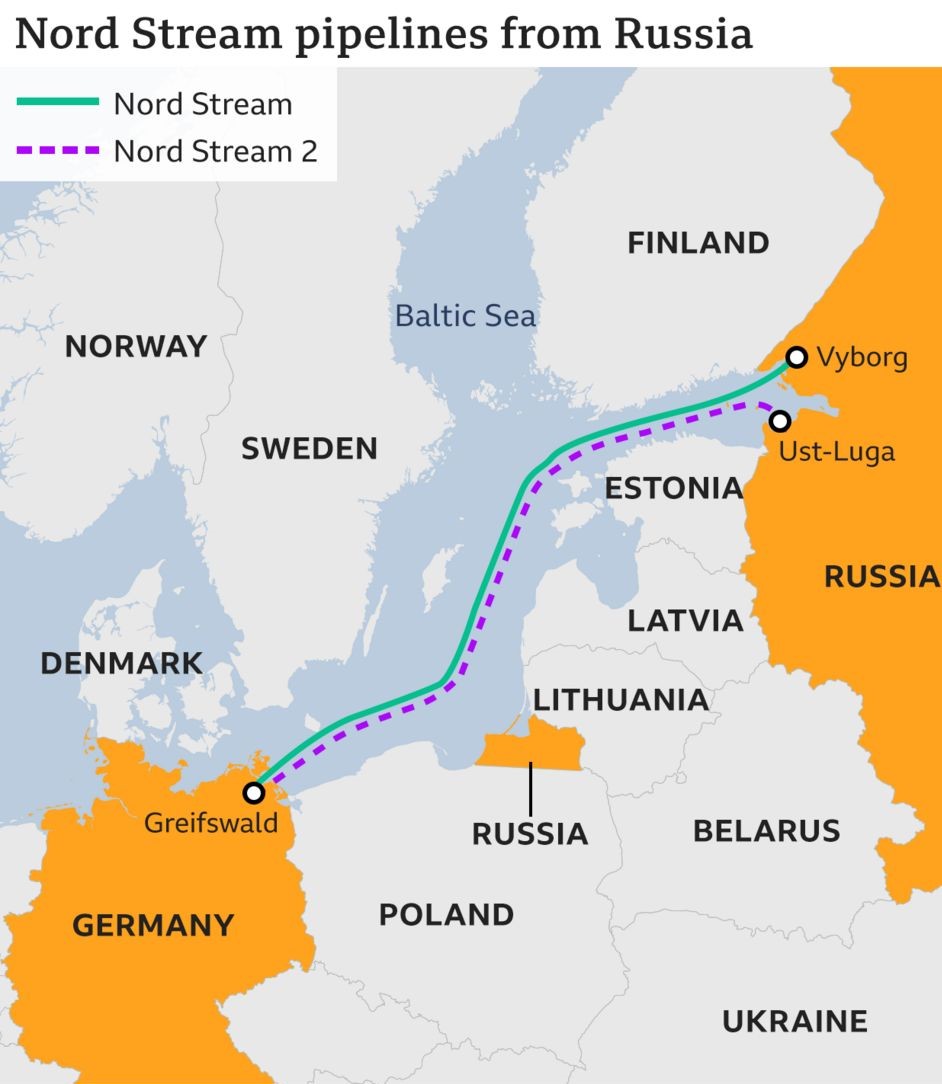
There are also signs that Moscow could send less gas in through another pipeline, the Yamal-Europe. Russia is thought to be withholding gas to pile pressure on European leaders to switch on a controversial pipeline, Nord Stream 2, which is built but still needs final approvals.

The squeeze on Europe next month will compound a mounting energy crisis in Britain that threatens to bankrupt dozens of small suppliers, bringing the meat industry to a halt and leave beer taps running dry.

At the same time, the National Grid is turning to “dirty coal” to help keep the lights on.

The UK’s three remaining coalfired power stations are on standby – or already being used – to fill gaps in the energy supply system. In September last year, coal was responsible for 0.5 per cent of UK electricity supply, but at the beginning of this week it was running six times higher at 3 per cent.

UK gas prices for October surged by 16 per cent to reach 188.1p a therm, while benchmark European gas prices rose by 16 per cent to 75.33 euros per megawatt hour.

The energy crisis has been brewing for several months, with low European supplies being a key part of this.

A long winter last year meant there was less stored gas going into summer, but Russia providing less also means countries have not built-up critical stores ahead of this winter.

Russia’s decision to cap additional supplies to Europe next month means time is running out. Storage facilities are around 72 per cent full – a level not seen at this time of year for around a decade.

The UK does not have any of its own gas storage sites, and a cold winter could force EU nations to send less power to the country.

Britain’s three coal-fired power stations are West Burton A in Lincolnshire, run by EDF, Ratcliffe-on-Soar, Nottinghamshire, owned by Uniper, and the Drax power station near Selby, North Yorkshire.

West Burton A has been fired up on several occasions in recent days in response to requests from the National Grid. And it now seems likely the country will be more reliant on coal-fired electricity this winter.

Standard
Arts, Books, Economic, History, Society

Book Review – ‘Work: A History of How We Spend Our Time’

REVIEW

IN 1776, Economist Adam Smith predicted that one day machines would “abridge labour”. We were meant to be able “to lie on the grass under trees on a summer’s day . . . watching the clouds float by”.

John Maynard Keynes, in the 1930s, thought that by now robots would be doing the donkey work, and food, water, warmth and safety would be “universal… and experienced equally by everyone”.

To which the only reasonable rejoinder or retort is: pig’s bottom. In 2020, owing to what James Suzman, a Cambridge professor, calls “cyber-physical systems animated by machine-learning algorithms”, i.e., computers, people are spending much longer staring at screens. In Britain in 2018, there were 600,000 work-related mental health issues reported to doctors.

In Professor Suzman’s reading of human history, nothing ever runs smoothly for long. For primitive peoples, life was “a constant battle”. When agriculture was developed, there were always droughts, floods and frost. What characterised us, however, was persistence. With the herding of animals came settlements and barns for grain, thence the need for carpenters, blacksmiths, merchants, stonemasons – eventually doctors, teachers and lawyers. Literacy enabled the keeping of accounts and the creation of banks.

The fatal paradox, though, is that gains in productivity are cancelled by population growth – more mouths to feed. Britain’s population in 1750 was 5.7 million, in 1851 21.1 million. Today it is nearly 70 million.

The Industrial Revolution behind the boom had little to recommend it: in the mines, children toiled like slaves. Women worked 14-hour shifts in mills. The working class were nothing but “a pin in a big machine”. Creativity was not wanted, only “target-driven, repetitive work”.

It has not been the proletariat, however, who benefit. Suzman quotes the alarming statistic that between 1978 and 2016, while the average pay increases were 11.7 per cent, the remuneration of CEOs went up by a staggering 937 per cent.

Clearly, we are victims of our ingenuity: we clear rainforests and generate greenhouse gases in the name of cheap food. Each year, 66 billion chickens are reared – triple the number of all wild birds.

Greed is the key to modern problems, what Suzman calls “the malady of infinite aspiration” – more microwave ovens, cars, phones. Nor is there a proportional correspondence between human labour and reward. What really counts if you want good prospects, are family connections, inheritance and “getting lucky”.

When order is under threat from human folly, Suzman says famines, wars and pandemics are the usual “imminent and severe correction” – so coronavirus should not be a surprise.

‘Work: A History of How We Spend Our time’ is published by Bloomsbury, 447pp

Standard
Britain, Economic, Government, Internet, Technology

5G and why we need it

TELECOMMUNICATIONS

5G

5G is the “fifth generation” upgrade to mobile telecommunications. It does not consist of a single new operating system but a “systems of systems” that will dramatically increase data speeds to such an extent you’ll be able to download a movie in just three seconds. It will also increase internet capacity a thousand-fold when it’s fully operational.

There is a big difference between 4G and 5G capabilities. 4G, like all the ‘G’s before it, is principally designed for smartphone browsing. 5G, however, is far more ambitious, linking together all kinds of devices, from household appliances such as fridges and washing machines to cars and electricity meters.

It is supposed to create what has been termed the “internet of things”, where everything we use in our day-to-day lives can be controlled remotely. For example, you could use the 5G network to control your washing machine from the other side of the world. It could also speed up the development of driverless cars by allowing vehicles to interact with each other.

5G will become increasingly relevant with a pressing need for it. In its strategy document for 5G rollout, published in 2017, the UK Government predicted that global data traffic would grow from 3.7 exabytes (3.7 billion-billion bytes of information, where one byte is equivalent to a short email) in 2015 to 30.6 exabytes in 2020. That’s the same as if the number of passengers on London’s Tube network grew by 53 per cent every year. Without an upgrade, existing systems face being overloaded.

There are also government policies which are dependent on 5G. If we are to reach net zero carbon emissions by 2050 – the ambitious target which was unveiled by former Prime Minister Theresa May last summer – then we will need to make much smarter use of the electricity grid. The 5G network would allow household appliances like fridges and electric car charges to switch in and out of the grid when needed.

There are risks with 5G. An “internet of things”, where every appliance is interconnected, provides new opportunities for hackers to interfere with electronic systems. They could potentially seize control of vehicles and cause them to crash, or by hacking smart door locks to gain entry to households.

Hostile nations could exploit 5G to try to disrupt our utility supplies, nuclear plants or airports. There are also serious privacy issues as 5G will make it easier for governments and corporations to track our lives one click at a time. But there are also considerable advantages – 5G networks involve far more secure data encryption. So, while there will be more appliances for hackers to target, doing so won’t be easy.


WHOEVER builds the 5G grid, or supplies equipment for it, could potentially plant bugs to allow interference with the network or enable mass surveillance by accessing data.

Huawei has repeatedly denied that it is an arm of the Chinese state, but as a Chinese company it is vulnerable to the control of a dictatorship with an appalling human rights record.

We wouldn’t allow a Chinese company to supply fighter jets for the RAF, goes the argument, and therefore we shouldn’t allow one to supply vital communications infrastructure.

Former national security adviser Lord Ricketts has dismissed the fears, however, saying: “I personally think we can find a solution which does allow them to have some role.”

Another serious concern is what it would mean for Britain’s role within the “Five Eyes” network of security partners – the US, Australia, Canada, New Zealand and Britain – who frequently exchange intelligence. Canada has yet to make a decision, while New Zealand initially stopped Huawei providing 5G equipment but has since said it has not imposed a complete ban.

The United States is worried. Donald Trump doesn’t trust Huawei to build even the smallest part of our 5G network and the US has warned that it might be reluctant to share intelligence with the UK if we utilise the services of the Chinese company – although MI5 chief Andrew Parker recently claimed that this is an unlikely consequence. Some analysts have argued that the US is only saying this as a protectionist ruse in its ongoing trade war with China.

Yet, that doesn’t explain why Australia, too, has banned Huawei from building its own 5G network. The chair of Australia’s intelligence and security committee, Andrew Hastie, claims it is a question of “digital sovereignty”, while his colleague James Paterson points out: “Successive Australian governments banned Huawei from our broadband and 5G networks with very little controversy.”

In any case, no US company currently makes 5G network equipment. Instead, the US is considering subsidising Swedish firm Ericsson and Finnish company Nokia in order to help develop its own 5G network. In the US, T-Mobile has already switched on a slower version of its 5G network, claiming it covers 200 million people.

Some of our other allies are also refusing to denounce the Chinese firm. German Chancellor Angela Merkel is reluctant to ban Huawei, fearing retaliation against German companies exporting to China. France, too, has said it will allow Huawei to build parts of its 5G network.

Under Theresa May’s premiership, the government announced that Huawei would be allowed to provide equipment for the periphery of the 5G network, such as masts, but not the control systems at the core of the network. The security services – MI5, MI6 and GCHQ – claim that the risk to 5G from using a Chinese supplier is manageable.

But one complication that will need to be resolved is that our existing 3G and 4G telecoms networks already contain equipment manufactured by Huawei. In 2005, for example, BT signed a contract with Huawei that allowed it to connect customer lines to the main part of the network.

The UK Government announced this week that it is to stick to its existing policy, which is to allow Huawei to build communication towers and other peripheral equipment for the 5G network but ban it from the core parts of the network (such as military intelligence). Measures were also announced to reduce future reliance on China’s involvement by imposing a 35 per cent cap on Huawei’s share of the market.

Our Government claims that Huawei has such a technological head-start in creating 5G equipment that shunning it would delay the introduction and considerably increase costs. Alternative, though significantly more expensive, suppliers are ZTE, which is owned by the Chinese government, Ericsson, Nokia, Samsung (South Korean) and Viettel (owned by the Vietnamese military). The actual cost to the Government of Huawei’s input into 5G is unknown, as is the time frame. Restricting Huawei’s involvement would have delayed the launch of 5G by up to two years and cost the economy between £4.5billion and £6.6billion, according to a 2019 report by the telecoms industry body, Mobile UK.

We could have decided to upgrade the existing 4G network which would have given extra capacity for now. But, in the long run, that would have led to Britain lagging behind in telecommunications.

The pros and cons of using Huawei

Advantages –

. Banning the Chinese would reduce the number of companies supplying 5G, decreasing competition and leading to a rise in costs for consumers.

. Whitehall officials have also said it would cost the UK economy tens of billions of pounds in the coming years, from the lost opportunity of the productive gains of using 5G.

. There would also be a cost to companies who have started to roll it out across the country.

. Officials have warned that by barring Chinese involvement could slow down the rollout of 5G by up to three years.

. Huawei’s exclusion would likely damage relations with China, where Britain is also seeking to strike a post-Brexit trade deal.

The Risks –

. The U.S. says Huawei could be used as a back door for spying by the Chinese state.

. Critics have also warned China could use its access to Britain’s data network to shut down critical national infrastructure.

. There are fears the UK could lose its intelligence sharing relationship with countries such as the US and Australia, who have warned against allowing Huawei anywhere near their networks.

. Members of the US Congress have also threatened to block a future post-Brexit trade deal if the UK pushed ahead with using Huawei.

Standard