Intro: Owen Matthews is a writer with close family ties to Russia, but a disturbing portrait of the Russian president’s propaganda is swallowed whole by his own people. The Russian despot’s lies are working. Overreach is the inside story of Putin’s war against Ukraine
READERS of foreign affairs’ news will know the name of Owen Matthews, a veteran Moscow correspondent, from articles and pieces he has written about Russia and Ukraine.
But his book on the war now raging between those two countries – an act of pure and vicious choice by President Putin – reveals for the first time the depth of his own family’s involvement in the complex background of conflicting national identities.
Or as he puts it: “We all like to believe that we think with our rational minds. But a little bit of us, a deep bit, thinks with our blood.” For Matthews’ mother, Lyudmila Bibikova, was born in Kharkiv, a predominately Russian-speaking city, at the heart of the Ukrainian territories Putin is determined to annex; and her own parents were both born in what is now, legally, Ukrainian land.
Yet as Matthews goes on to explain: “The Bibikov family did not consider themselves Ukrainian. For two centuries the Bibikovs played a significant role in Russia’s imperial role in Ukraine, first as servants of the Tsars and later as loyal lieutenants of Soviet power. Whether I like it or not my family history – my blood – is intimately linked not only to Ukraine and Russia but to the history of the Russian Empire.”
Although Putin is widely regarded as being highly motivated by a desire to reassemble the Soviet Union – and the secession of Ukraine in 1991 marked the end for the USSR – the Russian president sees himself as the heir to Catherine the Great, who brought most of Ukraine under the Kremlin’s rule.
And, as Matthews recounts, his ancestor, Captain Aleksandr Aleksandrovich Bibikov, was “one of the Russian officers who accompanied the empress on her first imperial progress through the newly conquered lands of south and west Ukraine”.
Intro: The balance of power in the European Union is shifting eastward
AS 2022 draws to a close, Russia’s war in Ukraine rages unabated. Russian President Vladimir Putin sees what he still calls a “special military operation” as a life-or-death contest with the United States and its NATO allies. The West, for its part, considers the war a threat to its own security and has thrown its weight behind the defence of Ukraine’s territorial sovereignty.
There is an inherent problem, however, with framing the war as a clash between the US and Russia. It underplays the spirit, resilience, and enormous daily sacrifices of Ukrainian’s in resisting their mighty neighbour bent on re-creating a Moscow-centred imperial order. Had there been no resolve among Ukrainians to fight back aggression and revanchism then no amount of military and financial aid for Kyiv would have been sufficient to thwart the Kremlin’s ambition.
That Eastern European countries and nations have agency and are more than pawns in the power struggles of larger players is imperative to understand. And it goes well beyond the example of Ukraine.
Poland has become a much more significant and influential player in European defence than it ever was. It is not just the fact that it is a front-line country which takes in many displaced refugees fleeing war from Ukraine, nor that it provides a land route to supply its neighbour with weapons and humanitarian aid, but, strategically, Poland is also ramping up its defence spending from 2.2 per cent of its gross domestic product to a record 3 per cent in 2023. That is one of the highest rates within NATO. The money will go into modernising and expanding its military forces and could make the Polish army one of the largest on the continent.
Warsaw is purchasing tanks and self-propelled howitzers from South Korea in a deal worth $5.8bn and will acquire state-of-the-art F35 fighter jets from the US in the future.
THE Berlin Wall may have been brought down more than three decades ago, but the grim politics of the Cold War are in danger of returning to Europe.
With characteristic ruthlessness, Russian president Vladimir Putin is exploiting the energy crisis to bully his neighbours, strengthen his autocracy and intimidate the West.
His chosen weapon in this renewed campaign of hostility is Russia’s control of gas supplies: the vast gas-fields and the export pipelines that bring them directly to market.
This infrastructure, often legacy assets from the Soviet empire, give the Russian president enormous political and economic leverage in his quest for ever-greater domination of the region.
Russia’s capacity to manipulate the British and European energy markets for geopolitical ends has been dramatically illustrated during the turmoil of recent days and weeks. As the price of gas contracts soared by 40 per cent in just 24 hours last week, Gazprom, Russia’s state-backed monopoly exporter of pipeline gas, was accused of flexing its muscles by both restricting supplies to Europe and keeping its European underground storage facilities at deliberately low levels.
The sense of Russian control was further reinforced when it took just a few words from Putin himself to bring an immediate fall in gas prices.
Revelling in his position as the ultimate ringmaster and wire-puller, he said with a hint of blackmail that supplies could be increased. “This speculative craze doesn’t do us any good,” he said, adding that Europe’s leaders should “settle with Gazprom and talk it over”.
RELIANCE
PUTIN might be behaving like a mafia boss in charge of a protection racket, but British and European governments have for years disastrously played into his hands with misguided, short-term policy decisions.
To be fair, the EU has taken some steps to break the Russian stranglehold, by building new international pipelines, breaking the Kremlin’s east-west transit monopoly, and by introducing drastic reforms of the energy market that have unravelled the corrupt, exploitative business model.
Europe has also pioneered the import of liquified natural gas (LNG) from destinations such as Qatar.
Yet Europe has been increasing its reliance on supplies from outside the continent by running down its own domestic energy industries. So far, renewables have not made up the gap, especially in recent months when the wind has not been blowing.
In Britain, the problem is particularly acute because we are one of Europe’s largest gas users, while we have massively reduced gas production from the rich fields of the North Sea and Irish Sea over the past 20 years.
Nor have we made use of the vast reserves of shale gas that exist across the country, even though such resources have recently made America “energy independent” once more.
Instead, Britain has exacerbated its energy vulnerability by depending on just-in-time imports from pipelines and seaborne cargoes.
In a particular act of folly, the Tory Government in 2017 decided to close the huge storage facility on the Yorkshire coast connected to the Rough gas field, believing both that supplies of LNG would always be plentiful and also because the energy companies believed that limiting storage would boost prices and thereby profits.
Some four years later, the step has backfired catastrophically, leaving us at the mercy of Putin.
Indeed, our entire energy strategy has been marked by stinginess, wishful thinking and downright complacency.
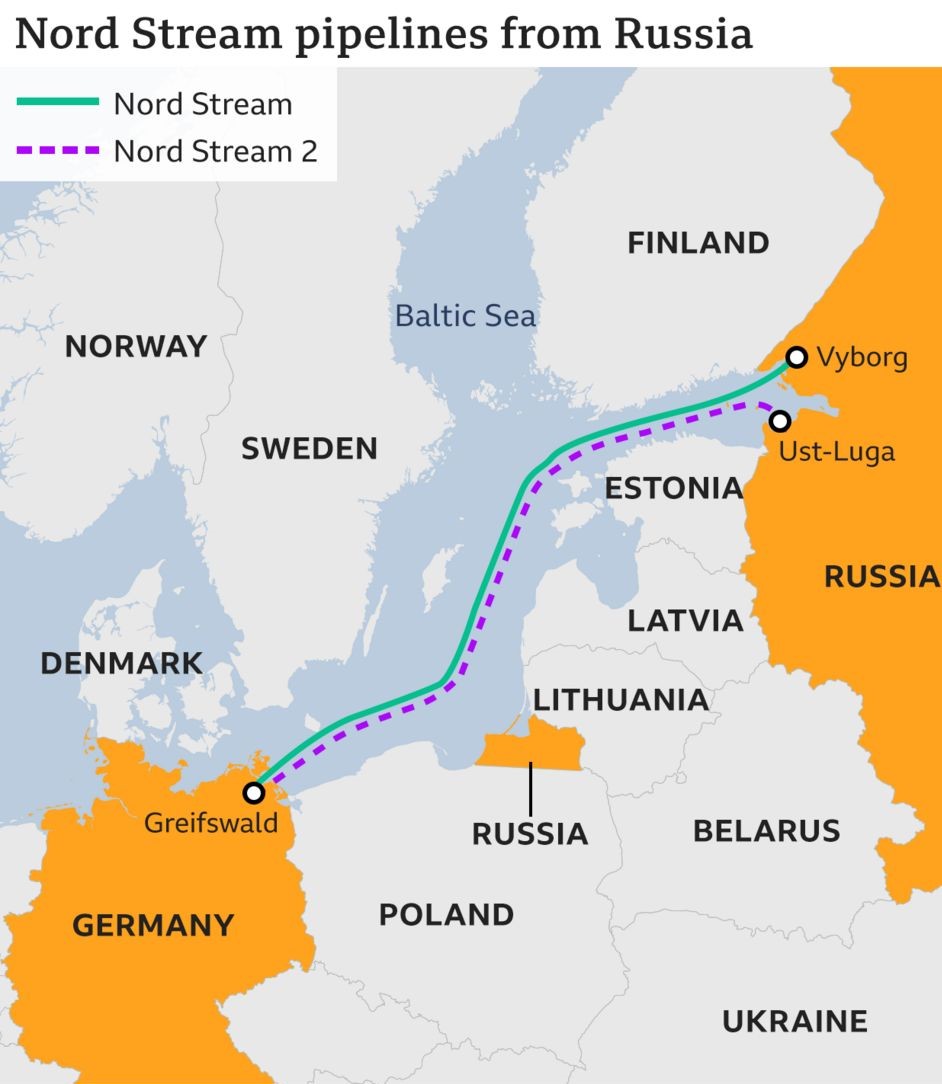
By manipulating energy markets, Putin’s immediate objective could not be clearer: he wants to pressurise Europe into approving immediately the operation of Gazprom’s controversial £8.1 billion Nord Stream 2 pipeline.
Now completed, this runs into Germany along the seabed of the Baltic Sea and bypasses Ukraine, in whose eastern regions Russia has been fighting a proxy war since 2014.
Critics say Nord Stream 2 will give too much influence to Russia over regional supplies and their prices.
But crucially, the project is backed by Germany, which puts cheap reliable supplies of Russian gas ahead of the security interests of its east European neighbours. US President Joe Biden’s administration, desperate to repair the damage done to relations with Europe under Donald Trump, has dropped American objections to the scheme.
The result is that Russia can now hold Ukraine and other Eastern European states to ransom. The Kremlin could shut down their gas without having to cut off the rest of Europe. In effect, one group of nations will be played off against the other in a fearful system of divide and rule, with Russia in command.
As Yuriy Vitrenko, the chief executive of Ukrainian energy giant Naftogaz, put it last week: “Moscow is withholding gas supplies in order to coerce Europe into accepting Nord Stream 2. Russia’s actions are the epitome of gas weaponisation. Anyone who refuses to acknowledge what Moscow is doing, especially when it does this so blatantly, is sending a dangerous message to the Russians that they can use gas to blackmail Europe and get away with it.”
TRAGEDY
GIVEN all this, it is almost inevitable that Ukraine will soon be plunged into another security crisis, perhaps even greater than the one that led to the annexation of Crimea in 2014. The fallout would be disastrous, especially in view of the fragility of Europe’s post-Covid economies.
The implications of Russia’s energy strength are brutal, leaving us relentlessly on the defensive. If, for example, Russia invaded Estonia, would NATO respond if Putin threatened to cut off Europe’s gas? The only way to break free from the shackles of energy dependency is to develop our own resources and means of storage.
In the 1970s, Western reliance on Middle Eastern oil created an era of regional conflict and economic crisis.
If today, the same were to happen because of our reliance on Russian gas, that too would be a tragedy.

 Arts, reviews & current affairs