
Arts, Books, Christianity, Natural History, Philosophy, Religion

The beehive tells us much about the soul

THE COMPLETE BEEKEEPER

Intro: The beekeeper at Douai Abbey has applied the wisdom of bee care to living well

During the vigil on the eve of Easter Sunday, the dark church is lit only by the Paschal candle (representing Christ, “Light from Light”, as the Creed says) and by the candles lit from it and held by those present. Then an ancient chant is sung by the deacon towards the candle, and in praise of it.

This chant, the Exsultet (“Rejoice”), written between 1400 and 1600 years ago, is of an astonishing poetical character. Its text refers to Adam’s sin as felix culpa, “happy fault that earned for us so great, so glorious a Redeemer”.

It speaks of “this candle, a solemn offering, the work of bees and of your servants’ hands”. But there should be another mention of bees – of the candle flame being “fed by melting wax, drawn out by mother bees to build a torch so precious”. The natural history may be awry in calling the female workers “mother bees”, but it is good to see them given due praise. Alas, some choose an abbreviated form of the Exsultent and the mother bees perished. To make up for that shortfall, a delightful new book is being published by Gracewing: The Complete Beekeeper by Dom Gabriel Wilson, OSB (Order of Saint Benedict).  

He has been Prior of the Benedictine Abbey of Douai in Berkshire since 2022, but its beekeeper since 2015. His tenure was a turning point in beekeeping history. He was in charge during the devastating Isle of Wight disease (now known to be caused by the Acarine mite) in the early 20th century, which wiped out the native British Black Bee. His writings capture a pivotal moment when beekeeping shifted from old-world methods to more scientific, selective breeding.

The book’s title mirrors The Compleat Angler, first published by Isaac Walton in 1653, which made the angler symbolise the ideal human being living a balanced life. Similarly, Dom Gabriel feels that “within the hive lives and moves an allegory for the sacred mysteries not only of nature, but of the human soul”.

The beehive speaks to the human heart, he suggests, not by logical syllogisms but by symbol. As Pascal wrote: “The heart has its reasons which reason does not know.”

Dom Gabriel notes that the social virtues of bees were recognised in the pre-Christian world. Virgil devoted a quarter of his poem the Georgics to bees as a model of a structured, co-operative, and selfless society. Today we still wonder: “Who taught the bee to make its wax hexagons, those most perfect forms? Who instructed her to gather nectar and guard her queen, to sacrifice herself to relentless work without any thought of reward?”

Nonetheless, The Complete Beekeeper is more than natural history or self-help; it is a contemplation of spirituality. “To keep bees is … a form of devotion, akin to an intimate spiritual practice that mirrors the tending of one’s inner life.”

The author’s experience at the beehive informs this meta-science: which, governs the care of the faculty for living well – the soul. “Each hive is its own living universe. Within its wooden walls, thousands of bees work in miraculous harmony: foraging, building, cleaning, dancing, feeding the queen, and protecting the whole. So too is the soul made up of countless thoughts, memories, desires, and instincts.”

The Complete Beekeeper taps inherited wisdom. It quotes poets such as Coleridge and Hopkins, and masters of the spiritual life such as St John of the Cross, and, naturally, St Benedict. It critically considers philosophers such as Plato, Seneca, and Sartre – and of course cites beekeepers, in peace and war.

The work of making one’s soul is deadly serious, but it should not be anxious. “Bees are not tame creatures; nor is the moral life a safe one. But it is, in the end, very beautiful and full of joy.” Underneath is a confidence in the ultimate goodness of the world, which, like the garden where the beekeeper tends his hives, knows how to bud and mend, grow and yield again.

Throughout the text, Wilson weaves in the Benedictine philosophy of stewardship. He advocates for a “gentle hand,” suggesting that the best beekeeper is one who works with the bees’ instincts rather than fighting against them. This philosophy – known as the “Buckfast” philosophy – of breeding for docility and productivity became the hallmark of the Buckfast Bee.

Many associate Buckfast Abbey primarily with Brother Adam (the creator of the Buckfast Bee), but it was actually Dom Gabriel who served as the Abbey’s head beekeeper before him. The bigger picture of the book implies that if Brother Adam was the “architect” of the Buckfast Bee, then Dom Gabriel was the “master builder” who cleared the ground. The analogy should not be overlooked.
   

Standard
Arts, Australia, Books, Literature

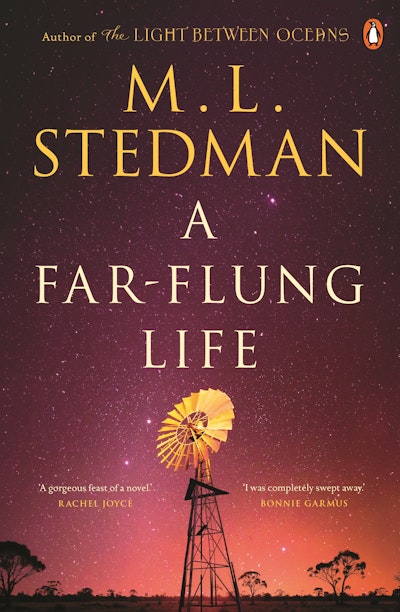
Book Review: A Far-flung Life

LITERARY REVIEW

The story is a sweeping epic that follows the MacBride family on a million-acre sheep station in Western Australia, exploring themes of secrets, tragedy, and resilience across several generations

In ML Stedman’s immensely popular 2012 debut, The Light Between Oceans, moral ambiguity was the eddying undercurrent, in a story about a couple who discover a baby on the shores of their remote island home off the coast of Western Australia. That novel spurred an international bidding war and sparked a lacklustre film adaptation. In her second publication, A Far-flung Life, Stedman remains just as preoccupied by what governs our understanding of right and wrong, as well as how we define our sense of family and identity.

Also set in Western Australia, A Far-flung Life begins in 1958 and follows several generations of the MacBride family on their million-acre sheep ranch, Meredith Downs. Here, small decisions have vast consequences: when the patriarch, Phil, swerves to avoid a kangaroo while driving home from the market, he and his eldest son, Warren, are killed. Matt, the youngest son, only just survives. Lorna, suddenly a widow, takes over the reins of the ranch, now the sole parent not only of Matt, whose amnesia from his head injury forces him to redefine who he is and the life he had once hoped for, but also of her “fiery, mercurial” daughter, Rosie.

As the years pass, other figures drift in and out of the MacBride orbit: there’s the taciturn Pete Peachey, a former prisoner of war in Japan who culls the kangaroos on the family homestead; and Miles Beaumont, a dapper Englishman of noble blood who’s learning the ropes on the station. Everyone has their secrets, the albatross they carry. Rosie’s causes her to flee to the outback, though she returns not long after, with a newborn in tow. She, too, will make a decision that reverberates for the MacBrides over the decades – particularly for Matt, who must learn what it means to live a life indelibly marked by unfathomable events.

A recurring theme through this attentive novel is a “forgetment”, a Stedman coinage and idea not for a memory but for a “thing you forget”. The struggle of writing our own narrative when it is violently altered and the way we are shaped as much by conscious knowing as by unknowing (what we hope time will dissolve) – these richly human notions are handled with skilled care. Just as the unflinching land can “rearrange itself without warning or permission”, so can our lives, our sense of self. As Pete Peachey reflects, “’Us’ is an ever-changing thing.” Throughout A Far-flung Life, the at-times herculean labour of weathering that change is shown as not an interruption of life but a part of it.

Time and its fickle passing are insightfully examined. The nature of loss and its temporal warping – where “one minute didn’t have the same length as another” – stands in counterpoint to the indifferent, relentless passage of time on the land. Hours, days, weeks: these human-made creations, the contours of which seem to blur, are only one way we mark our passage. There’s also “the gradual curl of a ram’s horns”, “the stretching and the shrinking of the light”. Stedman elicits, too, how when dazed by grief, one can experience time as stasis: for Matt, forever tied to a cataclysmic single moment, “maybe the roo was always going to bound in front of the truck; was still bounding in some eternal present”.

As the MacBrides learn how to endure the challenges besetting them, it’s a testament to Stedman’s deftness and skill that A Far-flung Life, racked with calamity, only occasionally approaches the mawkish. Every loss feels earned, and what may have otherwise been a syrupy saga is instead a palpable examination of loss, memory, and identity. Her breadth of research is also fully alive in the novel’s expansive detail: the landscape is rendered with intimate familiarity, as is the quotidian minutiae of life on the station. Stedman’s masterful control of perspective, shifting between multiple characters as well as expanses of time and place, culminates in a remarkable, poignant tale.

The moral ambiguity animating the novel lies in things which are best left buried; which parts of a life are allowed to become “forgetments”. This isn’t a question of feigned ignorance but rather of what role forgetting plays in forgiveness – not only of others but of oneself. The author holds the inquiry up like a glimmering piece of quartz, illuminating its shadowed recesses and fractures. The answers, she suggests, aren’t important as the life lived in pursuit of them.

A Far-flung Life by ML Stedman is published by Penguin, 448pp

Standard
Arts, Books, Education, Literature, Poetry

Book Review: Look Closer

NATIONAL YEAR OF READING

Intro: Published in late 2025, ‘Look Closer: How To Get More Out of Reading’ is the latest work by Robert Douglas-Fairhurst, a Professor of English Literature at Oxford.

Part memoir, part masterclass, the book is a “love letter” to the act of reading. The author argues that in our age of digital distraction and short-form content, the art of “slow reading” is more vital than ever

In the era of the smart phone and other devices, reading has become a dying art. In 2024, 40 per cent of Britons did not read or listen to a book. More than a third of adults are known to have given up reading for pleasure. In this digital age, it’s easy to see why. Small, compact devices have changed how we read: skimming rather than lingering over language, and the need to look for a quick fix of information.

Today, for too many of us, reading books has become a means to an end. We need to look no further than the armada of self-help authors promising to help you do it more quickly and, by implication, to read more overall. “Read more than 300 pages in one hour,” pledges one. “Speed Reading Faster: Maximise Your Success in Business and Study,” urges another.

The advice from literary artists is simple: ditch the idea that reading faster is better. Various movements have emerged in recent years, trying to help us get more out of life by taking it at a less frenetic pace: slow food, slow work, slow travel, even slow sex. “Slow reading” may sound rather different – the sort of thing that might evoke pity or scorn – but it can help break the bad habits into which many of us have fallen.

As the National Year of Reading is now upon us, there are certain things we can do to reverse the drift.

. Look closer at familiar classics

Some literary works have become so familiar that our eyes slide over them without stopping. But if we slow down our reading, even these works retain the power to surprise us – and to make us look at the world around us in a new and refreshing way.

Take the most famous speech in Hamlet:

“To be, or not to be, that is the question: Whether ‘tis nobler in the mind to suffer

The slings and arrows of outrageous fortune,

Or to take arms against a sea of troubles,

And by opposing end them?”

Hamlet’s famous question isn’t carried only by what he says, but by how he says it. That’s because his speech is written in lines of blank verse, 10 syllables long, that repeatedly topple over with an extra 11th syllable – “To be or not to be, that is the quest… ion” – then start again. Over and over, it’s synonymous with someone peering over the edge of a cliff before drawing back. Listening carefully to Hamlet allows us to see life (and death) from his perspective: the rhythm represents the way he’s thinking.

. Linger on little details

Another approach is to look again at a poem that’s often reprinted or published in anthologies – appropriate, since “anthology” literally means “a collection of flowers”:

I wandered lonely as a Cloud

That floats on high o’er Vales and Hills,

When all at once I saw a crowd

A host of dancing Daffodils;

Along the Lake, beneath the trees,

Ten thousand dancing in the breeze.

Wordworth’s ambition was to awaken a more imaginative response to homely or neglected corners of the world, and that aim is captured in the smallest details of his verse. The present participle “dancing” shows how something that happened in the past is still happening in his memory. His line breaks work like double-takes, as he searches for exactly the right word for what he saw: “a crowd / A host”.

Finally, his choice of “host” reveals how he detects a divine presence hovering in the background (angels as the heavenly host), while also suggesting that the sight of all these laughing daffodils has somehow made him feel more at home in the world. It’s another piece of writing that doesn’t give us a set of finished thoughts, but instead introduces us to a different way of thinking.

. Embrace the suggestive and opaque

Some literary works are so brief they function as highly effective training aids for this much more measured approach. For example, there’s a famous short story, often erroneously attributed to Ernest Hemingway, that reads: “For sale: baby shoes, never worn.” That’s it – a tragedy in just six words. Written more than 30 years ago, it is still being thought about today.

Like all the best pieces of writing, it works like an imaginary dumdum bullet: it enters our minds and keeps on expanding. (If you want to discover who the original author was, you’re likely to be disappointed. Versions of this story date back to the early 1900s, and a classified ad reading “For sale: baby carriage, never used” can be found in an American newspaper published in 1883.)

. Ask yourself – or Sherlock – what a good reader is

Some books even contain helpful clues about how to read them. A character such as Sherlock Holmes is a model reader, for instance, because he notices every detail and shows how they combine into a meaningful whole. He sifts life for significance. Take The Boscombe Valley Mystery: Holmes assembles a whole series of tiny clues, including a bit of cigar ash that he establishes is from an Indian cigar, and a boot print that he deduces was made by someone with a limp.

At one point he says to Watson, “you see…”, and although it’s only a passing remark, it also works like a miniature version of the whole story. A literary detective makes us “see”, in the sense of showing us how to use our eyes more carefully, and then makes us “see” in the sense of understanding more about what we’ve just been reading (“Oh, I see!”).

In his 1881 book Daybreak (Morgenröthe), Friedrich Nietzsche explained that he was “a teacher of slow reading”. In an age of work, he wrote, “that is, of haste, of unseemly and immoderate hurry-scurry, which is so eager to ‘get things done’”, what was needed was an approach that would teach people “how to read well, that is, slowly, profoundly, attentively, prudently, with inner thoughts, with the mental doors ajar”.

Nearly half a century and a half later, slow reading is something we need more than ever. We need to break the habit of reading just for information, on the page as well as online; we must get out of that horrid, uneven rhythm of scanning and skipping.

For when we pick up a book, we aren’t only trying to lose ourselves in it. If we’re willing to look closely enough, and to leave our mental doors ajar, we might find ourselves there.

Look Closer by Robert Douglas-Fairhurst is published by Fern Press, 352pp

Standard